
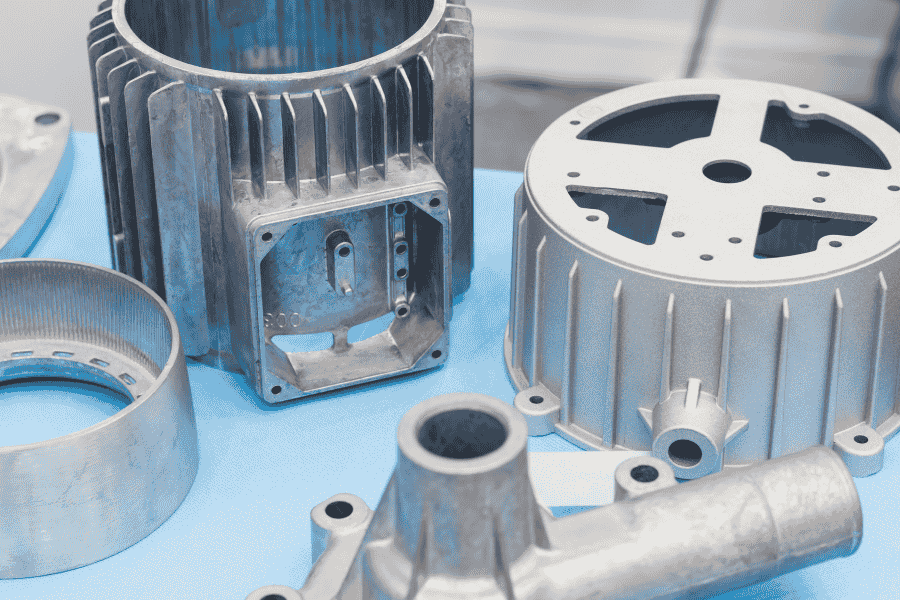
In the world of non-ferrous casting, selecting the right material is the single most important decision an engineer makes. It dictates the weight, the cost, and most importantly, the strength of the final component. However, the nomenclature of alloys can be confusing. Global supply chains mean that UK engineers frequently encounter American specifications, leading to a common question: “What is the difference between LM25 and A356?”
These two alloys are the heavyweights of the aluminium casting world. They are the “go to” choices for high-strength, safety-critical components in aerospace, automotive, and defence. On paper, they look almost identical. In practice, they are often interchangeable, provided you understand the nuances of their heat treatment and impurity levels.
Castech casts both alloys daily. Whether you need a high specification Aluminium Casting for a drone body or a pressure-tight pump housing, understanding the subtle battle between LM25 and A356 helps you ensure structural integrity without over-engineering. This guide breaks down the chemistry, the strength data, and the real-world applications of these two metallurgical siblings.
The Quick Answer
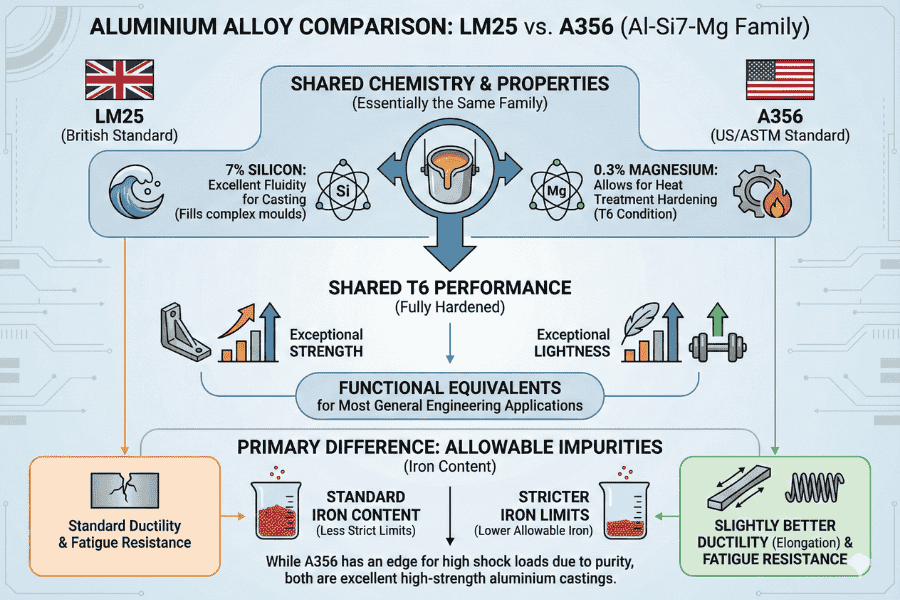
LM25 (British Standard) and A356 (US/ASTM Standard) are essentially the same alloy family (Al-Si7-Mg). They both rely on 7% Silicon for excellent fluidity during casting and roughly 0.3% Magnesium to allow for heat treatment hardening. When heat-treated to the T6 condition (fully hardened), both offer exceptional strength and lightness. The primary difference lies in the allowable impurities. A356 generally has stricter limits on Iron content than standard LM25, which gives A356 slightly better ductility (elongation) and fatigue resistance. However, for most general engineering applications, they are functional equivalents.
The Chemistry: Why Are They So Similar?
To understand their strength, we must look at what makes them tick chemically. Both alloys fall into the “Al-Si-Mg” (Aluminium-Silicon-Magnesium) family.
1. The Role of Silicon (7%) Both alloys contain roughly 6.5% to 7.5% Silicon. Silicon is the “caster’s friend.” It creates a eutectic mixture that melts at a lower temperature and flows like water. This allows the molten metal to fill complex moulds with thin walls without freezing prematurely. This is why both alloys are perfect for intricate Investment Casting or complex sand moulds.
2. The Role of Magnesium (0.3% – 0.4%) Magnesium is the “hardener.” By itself, aluminium is soft. When Magnesium is added, it allows the alloy to respond to heat treatment. During the heat cycle, the Magnesium combines with the Silicon to form Magnesium Silicide (Mg2Si) precipitates. These microscopic crystals act like pins within the metal’s grain structure, locking it together and drastically increasing the tensile strength.
The Iron Difference
This is the main technical distinction.
LM25: The British Standard (BS 1490) historically allowed for slightly higher Iron content (up to 0.5% in some grades). Iron is an impurity that can form brittle needles in the microstructure, reducing ductility.
A356: The American Standard typically caps Iron at 0.2% or lower. This purity ensures the metal stretches farther before snapping (elongation), making A356 slightly superior for parts subject to high shock loads.
However, high-quality UK foundries like Castech typically use “Primary Grade” LM25 ingots anyway, which have very low iron levels, effectively narrowing this gap.
Strength Comparison: The Numbers
Strength in casting is not a single number. It is a trio of properties: Tensile Strength (when it breaks), Yield Strength (when it permanently bends), and Elongation (how much it stretches).
Both alloys are weak in their “As Cast” state. To unlock their true potential, they must undergo heat treatment, typically to the T6 condition.
LM25-T6 (British Standard)
Tensile Strength: 230 – 280 MPa
Yield Strength: 180 – 220 MPa
Elongation: 2% – 5%
LM25-T6 is the industry standard for general engineering. It is rigid, strong, and machines beautifully. It holds a good edge and is corrosion-resistant.
A356-T6 (US Standard)
Tensile Strength: 230 – 290 MPa
Yield Strength: 185 – 230 MPa
Elongation: 3% – 6%
You can see the overlap. A356-T6 often edges ahead slightly on Elongation due to its lower iron content. This makes it the preferred spec for aerospace components, where even a microcrack could be catastrophic.
The Vital Role of Heat Treatment (T6)
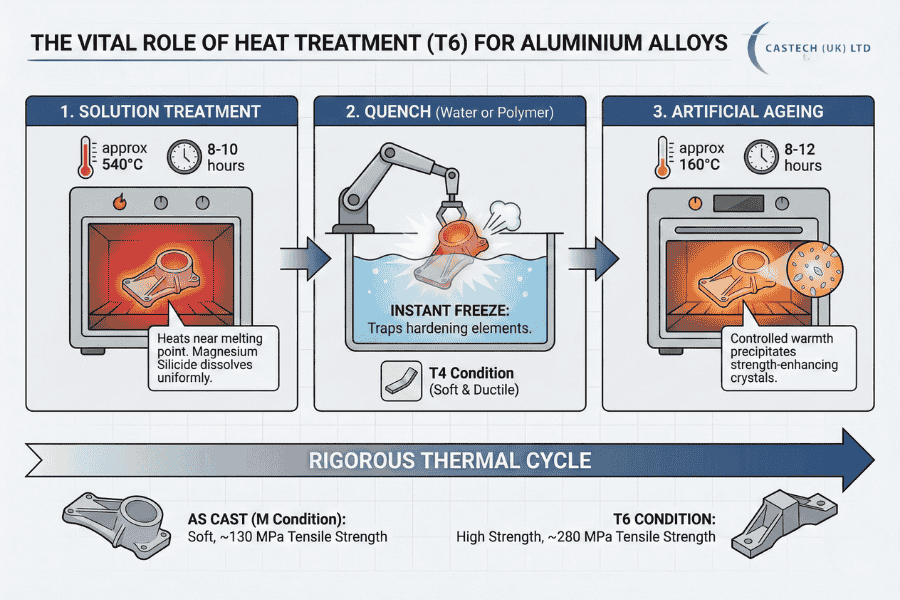
You cannot discuss the strength of these alloys without discussing heat treatment. If you cast LM25 and let it cool naturally (M condition), it is soft. It might only have a tensile strength of 130 MPa.
To get to the 280 MPa required for a high-performance car part, we put the castings through a rigorous thermal cycle:
1. Solution Treatment (approx 540°C for 8-10 hours): We heat the casting near its melting point. This dissolves the Magnesium Silicide uniformly into the aluminium, “resetting” the structure.
2. Quench (Water or Polymer): The hot casting is plunged into warm water. This freezes the structure instantly, trapping the hardening elements in place. At this stage, the metal is actually quite soft and ductile (T4 condition).
3. Artificial Ageing (approx 160°C for 8-12 hours): We reheat the casting to a lower temperature. This controlled warmth encourages the Magnesium Silicide to precipitate out into those strength-enhancing crystals we mentioned earlier. This is the T6 condition.
Manufacturing Process Effects: Sand vs. Die
The strength of LM25 or A356 is not just about the metal; it is about how quickly it cools.
Sand Casting
In Sand Casting, silica sand acts as an insulator. The molten aluminium cools relatively slowly. This results in a coarser-grained structure. While still strong, a sand cast LM25-T6 part will typically be slightly lower in mechanical properties than a chill cast part.
Gravity Die Casting
In Gravity Die Casting, the metal is poured into a steel mould. Steel conducts heat away rapidly. This “chills” the liquid aluminium, causing it to freeze almost instantly. This rapid solidification creates a very fine, tight grain structure. As a result, a die-cast part in A356 or LM25 will almost always be stronger and tougher than the same shape cast in sand.
Chemical Modification (Strontium)
There is a “secret ingredient” used in high-strength aluminium casting called Strontium.
Under a microscope, the silicon in standard aluminium looks like jagged flakes. These flakes act as stress risers (weak points) where cracks can start. By adding a tiny amount of Strontium to the melt just before pouring, we “modify” the silicon. It changes shape from jagged flakes to fibrous, coral-like structures.
This simple chemical trick significantly boosts the strength and ductility of both LM25 and A356.
Which Should You Choose?
If you are a UK-based engineer designing a new component, which callout should you put on the drawing?
Choose LM25 if:
You are working to British Standards (BS 1490).
The part is for general industrial, marine, or automotive use.
Availability of ingot is a priority in the UK supply chain.
You need excellent corrosion resistance (LM25 is excellent in seawater).
Choose A356 if:
You are working to US aerospace or military standards (MIL-SPEC).
The part requires slightly higher ductility (elongation) to resist shock loads.
You are exporting to the US market, where A356 is the recognised norm.
Real World Applications
Due to their high strength-to-weight ratio, these alloys are found everywhere.
Automotive: Cylinder heads, engine blocks, and alloy wheels are almost exclusively made from A356 or LM25 types.
Defence: Tank track tensioner wheels and missile components rely on the T6 heat-treated strength.
Marine: Pump bodies and deck fittings utilise the natural corrosion resistance of the Silicon-Magnesium chemistry.

Conclusion
The battle between LM25 and A356 is essentially a draw. They are two different names for the same fundamental chemistry: a versatile, heat treatable aluminium alloy that bridges the gap between castability and strength.
While A356 has a slight edge in ductility due to purity controls, a premium quality LM25 casting produced by a competent foundry will perform just as well in 99% of applications. The key to strength lies not just in the name on the drawing, but in the quality of the foundry process, the precision of the heat treatment, and the integrity of the melt.