
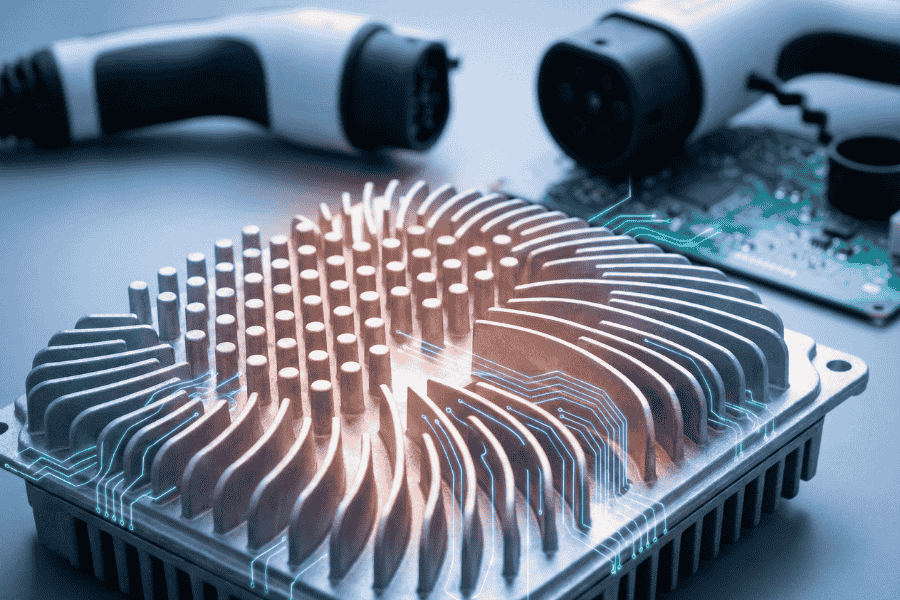
In the modern engineering landscape, the demand for components that can handle high electrical loads while managing intense heat is skyrocketing. From the rapid rollout of Electric Vehicle (EV) infrastructure to the miniaturisation of high-power electronics, designers are constantly hunting for materials that offer the perfect balance of performance, weight, and cost.
Copper has traditionally been the “gold standard” for conduction. However, it is heavy, expensive, and difficult to cast into complex shapes. This is where Cast Aluminium steps in as the industry workhorse.
The short answer is yes. While aluminium is less conductive than copper by volume, it is vastly superior by weight. When you combine this with its ability to be cast into intricate “Fin & Pin” heatsink designs, it becomes the material of choice for the green energy revolution.
This guide explores the science of conductivity, the unique advantages of cast heatsinks, and why aluminium is the backbone of the EV charging industry.
The Quick Answer
Cast Aluminium is an excellent electrical conductor, typically offering 61% of the conductivity of copper (IACS). However, because it is one-third the density of copper, an aluminium part is actually twice as conductive as a copper part of the same weight. This makes it ideal for weight-critical applications like EVs. Furthermore, its high Thermal Conductivity allows it to act as a dual-purpose component: conducting electricity for grounding/shielding while simultaneously dissipating heat through complex cast features like Pin Fins, which are impossible to manufacture cost-effectively with machining alone.

Electrical Conductivity: The “61% Rule”
To understand how well-cast aluminium conducts electricity, we use the International Annealed Copper Standard (IACS). Pure copper is the baseline at 100%.
Most cast aluminium alloys (such as LM25 or A356) sit at approximately 40% to 50% IACS, while purer electrical grades can reach 61%. At first glance, this suggests aluminium is “worse” than copper. However, this volume-based comparison ignores the most critical factor in modern engineering: mass.
The Mass Advantage
Copper Density: 8.96 g/cm³
Aluminium Density: 2.70 g/cm³
To carry the same current as a copper bar, an aluminium bar needs to be larger in cross-section. However, because aluminium is so light, the larger bar will still weigh 50% less than the copper equivalent. For industries like Aerospace and Automotive, where every gram of weight reduces range and efficiency, cast aluminium is the superior electrical choice for housings, grounding straps, and busbar supports.
Thermal Conductivity: The Partner of Electricity
In electronics, electricity creates heat. The better your component conducts electricity, the more current you push through it, and the hotter it gets. If you cannot move that heat away, the electronics fail.
This is where cast aluminium shines. It is not just an electrical conductor; it is a thermal sponge. High-quality aluminium castings offer thermal conductivity of around 150–170 W/m·K. This property allows a cast component to serve three functions simultaneously:
Structural: Holding the heavy PCB or battery cells.
Electrical: Providing EMI (Electromagnetic Interference) shielding and a ground path.
Thermal: Drawing heat away from sensitive chips and dumping it into the air.

Heatsink Innovation: The “Fin & Pin” Revolution
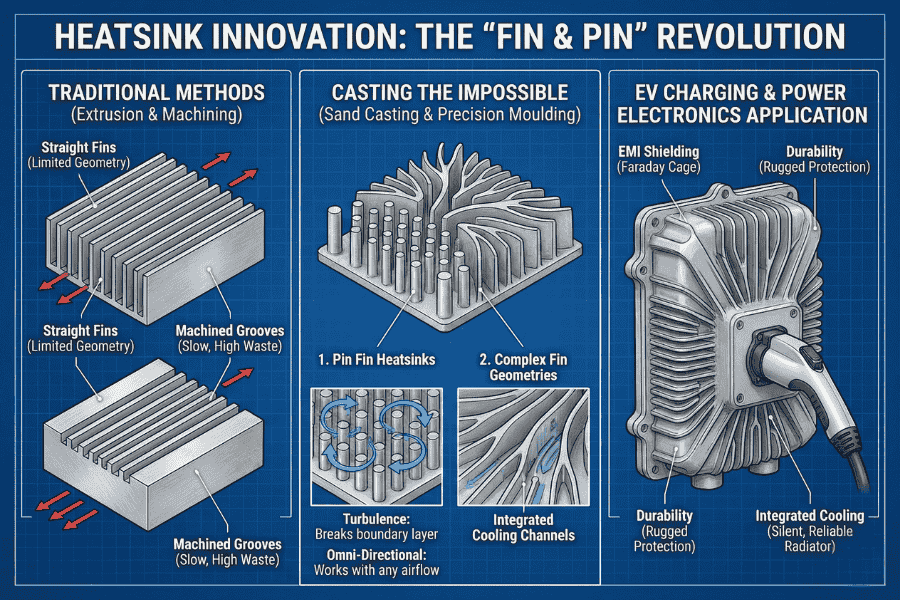
The efficiency of a heatsink depends on its surface area. The more surface area you have in contact with the air, the faster the heat dissipates. Traditionally, heatsinks were extruded (creating long straight fins) or machined (cutting grooves into a block). Both methods have limits. Extrusions can only make straight lines. Machining is slow and generates massive waste.
Casting the Impossible At Castech, our Sand Casting and precision moulding processes allow us to create 3D geometries that machining cannot touch. This has led to the rise of Fin & Pin designs.
1. Pin Fin Heatsinks Instead of long walls, the heatsink is covered in thousands of tiny cylindrical or square pillars (pins).
Turbulence: Air does not just flow over a pin; it swirls around it. This turbulence breaks the “boundary layer” of stagnant hot air, significantly increasing cooling efficiency.
Omni-Directional: Standard fins only work if the airflow is parallel to the fins. Pin fins work no matter which way the wind blows, making them perfect for passive cooling in outdoor EV chargers.
2. Complex Fin Geometries We can cast fins that curve, taper, or branch out like a tree. We can cast internal cooling channels directly into the wall of the housing. This allows the chassis of the device to become the heatsink, removing the need to bolt on a separate copper block.
EV Charging and Power Electronics
The electric vehicle charging industry is the primary driver for these high-performance castings. A generic 7kW home charger might use plastic. But a 150kW DC Fast Charger is a high-voltage beast that generates immense heat.
The Role of Cast Aluminium in EV Charging:
EMI Shielding: High-frequency switching in chargers creates “noise” that can disrupt other electronics. An aluminium enclosure acts as a Faraday cage, blocking this interference. Plastic cannot do this.
Durability: Public chargers are exposed to rain, vandalism, and vehicle impacts. A cast aluminium housing offers rugged protection that brittle plastic or rusting steel cannot match.
Integrated Cooling: By using a “Fin & Pin” cast design for the main housing, the entire charger acts as a radiator. This removes the need for noisy, power-hungry cooling fans, making the charger silent and more reliable.
Surface Finishes: Conducting vs. Insulating
A critical detail for electrical engineers is the surface treatment. Aluminium naturally forms an oxide layer which is electrically insulating. If you need your cast part to conduct electricity (e.g., for grounding), the finish matters.
1. Anodising (Insulating) This creates a hard, durable, ceramic-like surface. It is non-conductive. If you anodise a heatsink, you must mask off the contact points (where the screws go) to ensure a ground connection.
2. Alochrom / SurTec 650 (Conductive) This is a chemical conversion coating. It protects against corrosion while maintaining low electrical resistance. This is the industry standard for electronics housings where the case must act as an electrical shield.
At Castech, we offer comprehensive in-house finishing services, ensuring your parts arrive ready to install, whether they require electrical activation or are fully insulated.
Conclusion
Cast aluminium is not a compromise; it is a strategic material choice. It offers the unique ability to conduct electricity efficiently, shed heat rapidly, and be moulded into complex “Fin & Pin” shapes that maximise performance.
For the electronics and EV industries, it provides the lightweight, robust, and thermally efficient foundation that modern power systems require.
Whether you are designing a new ruggedised tablet, a military radio, or the next generation of roadside EV chargers, Castech has the expertise to turn your thermal and electrical challenges into a single, precision-cast solution.