
In an era of mass production, where millions of identical components roll off assembly lines every day, there remains a critical need for the unique. Whether it is a prototype for a revolutionary new medical device, a replacement component for a vintage aircraft that has been out of production for fifty years, or a specialised fitting for a nuclear power plant, off-the-shelf solutions simply do not suffice.
This is the domain of Custom Machined Parts.
At Castech, while our heritage is in the foundry, our Precision CNC Machining capabilities are the sharp end of our business. We do not just pour metal; we shape it to micron-level perfection. We understand that for many of our clients, the part they need does not exist in a catalogue. It exists only on a digital drawing or in the mind of a design engineer.
This guide explores the world of bespoke manufacturing, explaining how we turn raw blocks of metal into complex functional geometry, the costs involved, and why custom machining is often the only viable solution for high-performance engineering.
The Quick Answer
Custom Machined Parts are unique components manufactured to specific customer requirements using Computer Numerical Control (CNC) technology. Unlike mass-produced items created via moulding or stamping, custom parts are typically made using “subtractive manufacturing.” We take a solid block of material (a billet) or a raw casting and use high-speed cutting tools to remove material until only the desired shape remains. This process offers the highest possible level of precision (often within 0.005mm) and mechanical strength, making it ideal for low-volume production, prototyping, and critical aerospace or defence applications.
The Process: From Digital to Physical
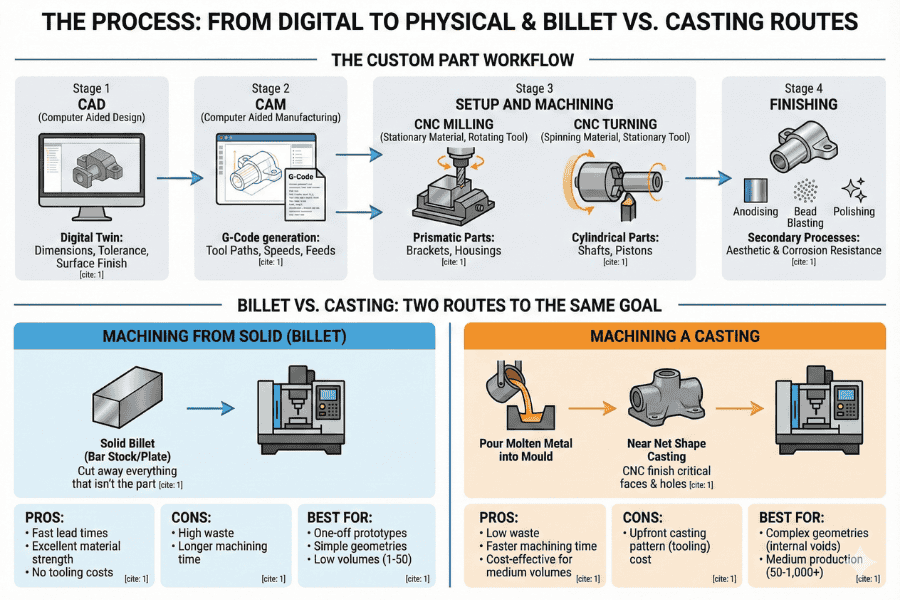
The journey of a custom part is a marriage of digital design and physical force. It follows a strict workflow to ensure that the final piece matches the intent of the designer perfectly.
1. CAD (Computer Aided Design)
Everything starts with a 3D model. The engineer creates a digital twin of the part using software like SolidWorks or AutoCAD. This file contains every dimension, tolerance, and surface finish requirement.
2. CAM (Computer Aided Manufacturing)
The CAD file is not enough for the machine. We need to tell the machine how to cut it. CAM software translates the 3D model into “G-Code” – the language of CNC machines. It calculates the tool paths: “Move the cutter to X:50, Y:30, Z:-5 at a speed of 2000 RPM.”
3. Setup and Machining
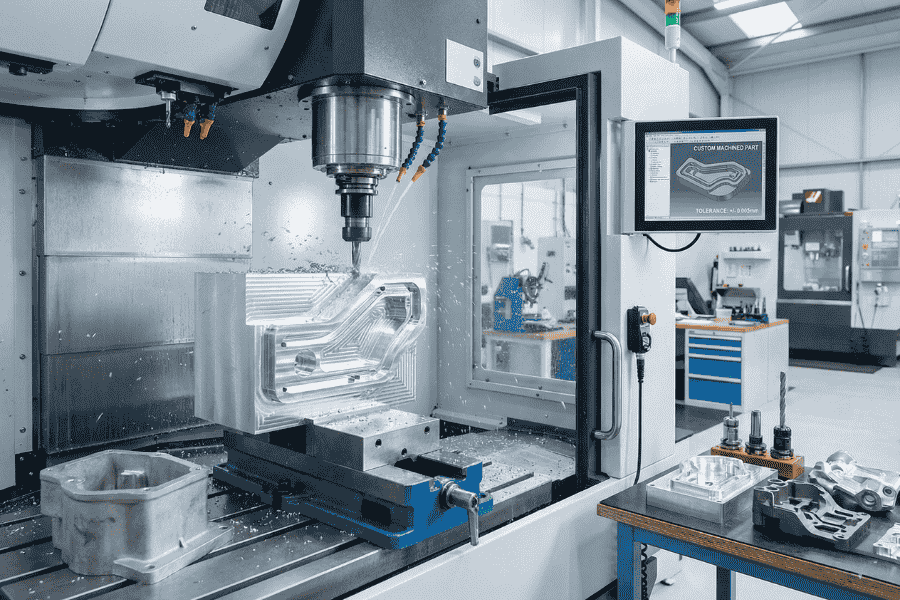
A skilled machinist loads the raw material into the CNC machine.
CNC Milling: The material is held stationary in a vice, and a rotating cutting tool moves around it to carve out shapes. This is used for prismatic parts like brackets, housings, and engine blocks.
CNC Turning (Lathe): The material spins at high speed, and a stationary tool shaves away metal. This is used for cylindrical parts like shafts, pistons, and pins.
4. Finishing
Once machined, the part may show tool marks. Custom parts often undergo secondary processes like anodising (for aluminium), bead blasting (for a matte finish), or polishing to meet aesthetic or corrosion resistance standards.
Billet vs. Casting: Two Routes to the Same Goal
One of the unique advantages of Castech is that we offer two distinct routes to creating a custom-machined part. We can machine from a Solid Billet, or we can machine a Casting.
Machining from Solid (Billet)
We take a solid block of metal (bar stock or plate) and cut away everything that isn’t the part.
Pros: incredibly fast lead times (no need to make a mould first), excellent material strength, and no tooling costs.
Cons: High waste (you might turn 50% of the expensive metal into scrap chips) and longer machining time per part.
Best For: One-off prototypes, simple geometries, or very low volumes (1-50 parts).
Machining a Casting
We first pour molten metal into a mould to create a “Near Net Shape” part, then use CNC machining only to finish the critical faces and holes.
Pros: Low waste, faster machining time, and cost-effective for medium volumes.
Cons: You have to pay for the casting pattern (tooling) upfront.
Best For: Complex geometries (like internal voids) and medium production runs (50-1,000+ parts). You can read more about this in our Sand Casting guide.
Materials: The Palette of Precision
Custom machining offers a wide range of material options. Unlike injection moulding, which is limited to plastics, or die casting, which is limited to low-melting-point metals, CNC machining can cut almost any rigid material.
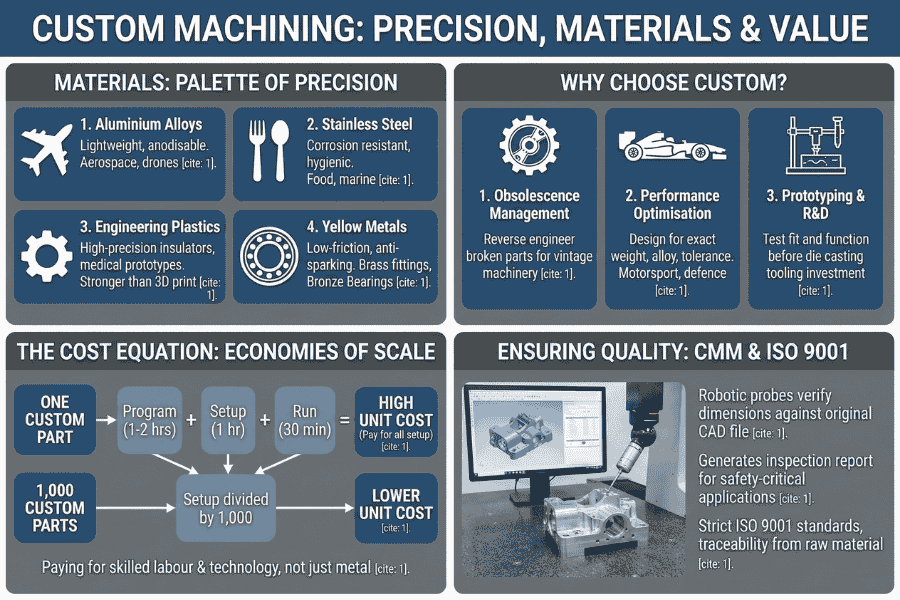
1. Aluminium Alloys (6061, 7075, LM25) The most common choice. It is lightweight, easy to machine, and can be anodised in any colour. It is the standard for aerospace housings and drone components.
2. Stainless Steel (303, 304, 316) Used where corrosion resistance or hygiene is paramount. It is harder to machine than aluminium, requiring slower speeds and harder tools, which increases the cost. It is essential for the food industry and marine applications.
3. Engineering Plastics (Acetal/Delrin, Nylon, PEEK) We don’t just cut metal. Machining plastics allows for high-precision insulators, gears, and medical prototypes that are stronger and more accurate than 3D printed alternatives.
4. Yellow Metals (Brass, Bronze) As a non-ferrous specialist, we machine a significant volume of Copper alloys. From decorative Brass fittings to high-load Bronze Bearings, these materials offer unique low-friction and anti-sparking properties.
Why Choose Custom Machining?
Why go to the trouble of commissioning a custom part rather than buying something off the shelf?
1. Obsolescence Management Machines last longer than the companies that made them. If a critical bracket breaks on a 1960s printing press or a vintage tractor, you cannot buy a spare from Amazon. Custom machining allows us to “Reverse Engineer” the broken part, draw it, and manufacture a brand new replacement that is often stronger than the original.
2. Performance Optimisation Standard parts are compromises. A custom part is designed for your exact problem. You can specify the exact weight to save fuel, the exact alloy to resist heat, and the exact tolerance to prevent vibration. In motorsport and defence, this marginal gain is the difference between winning and losing.
3. Prototyping and R&D Before investing £50,000 in a die casting tool, you need to know the design works. Machining a custom prototype from solid billet allows you to test the fit and function in the real world. If the design needs changing, you just update the CAD file and cut another one.
The Cost Equation: Why is Custom More Expensive?
A common question we face is: “Why does this single bolt cost £50 when I can buy a bag of bolts for £5 at the hardware store?”
The answer lies in economies of scale and setup time. To make one custom part, an engineer has to:
Program the machine (1-2 hours).
Set up the tools and fixtures (1 hour).
Run the machine (30 minutes).
If you order one part, you pay for all that setup time. If you order 1,000 parts, that setup time is divided by 1,000, making the unit price drastically lower. Custom machining is a service, not a commodity. You are paying for the skilled labour and the technology, not just the metal.
Ensuring Quality: The CMM
With custom parts, there is no room for error. If the hole is 0.05mm too small, the part is scrap.
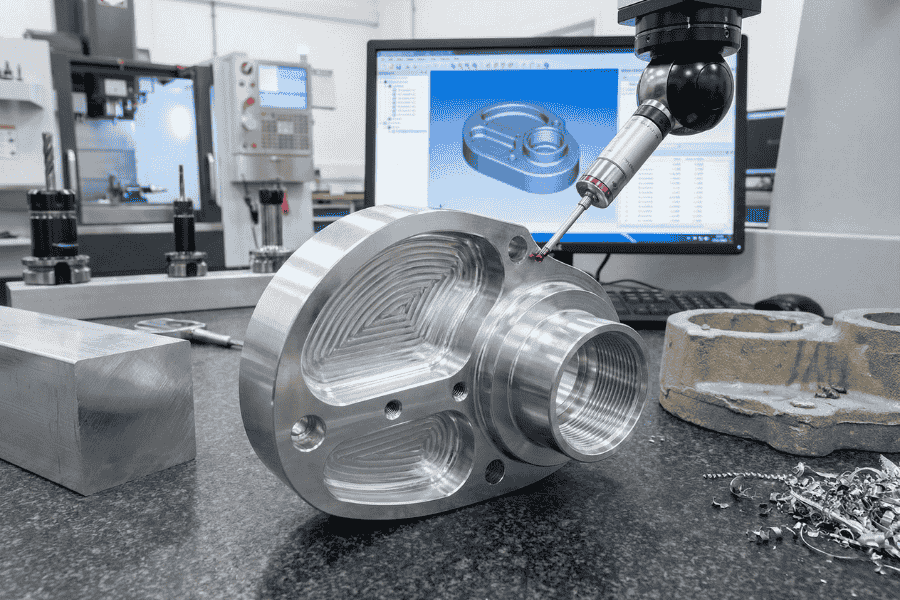
To ensure perfection, Castech employs Coordinate Measuring Machines (CMM). These are robotic probes that touch the finished part at precise points to verify the dimensions against the original CAD file. This generates a detailed inspection report, providing our clients with the certification they need for safety-critical applications. We operate to strict ISO 9001 standards, ensuring traceability from the raw material ingot to the finished component.
Conclusion
Custom machined parts are the problem solvers of the engineering world. They bridge the gap between mass production and unique necessity. They keep vintage machinery running, they enable cutting-edge innovation, and they ensure that critical infrastructure operates safely.
At Castech, we are proud to offer a complete solution. Whether you need a single prototype machined from solid bar or a batch of 500 intricate castings machined to micron tolerances, we have the expertise and the equipment to deliver.
By combining our foundry heritage with modern CNC precision, we provide a “one-stop shop” for bespoke manufacturing in the UK.