
In the foundry industry, temperature is our most critical tool. It is the variable that transforms a solid ingot into a fluid capable of taking on intricate shapes, before returning it to a solid state that can withstand immense stress. However, the concept of a “melting point” is rarely as simple as a single number on a thermometer.
For a precision non-ferrous foundry like Castech, understanding the melting characteristics of Aluminium, Copper, and Zinc alloys is fundamental to the quality of the final component. If the metal is too cool, it will fail to fill the mould (a misrun). If it is too hot, it absorbs gas, oxidises, and degrades the metallurgical structure.
This guide explores the science of melting points, why alloys behave differently from pure metals, and how these thermal properties dictate the casting process.
The Quick Answer
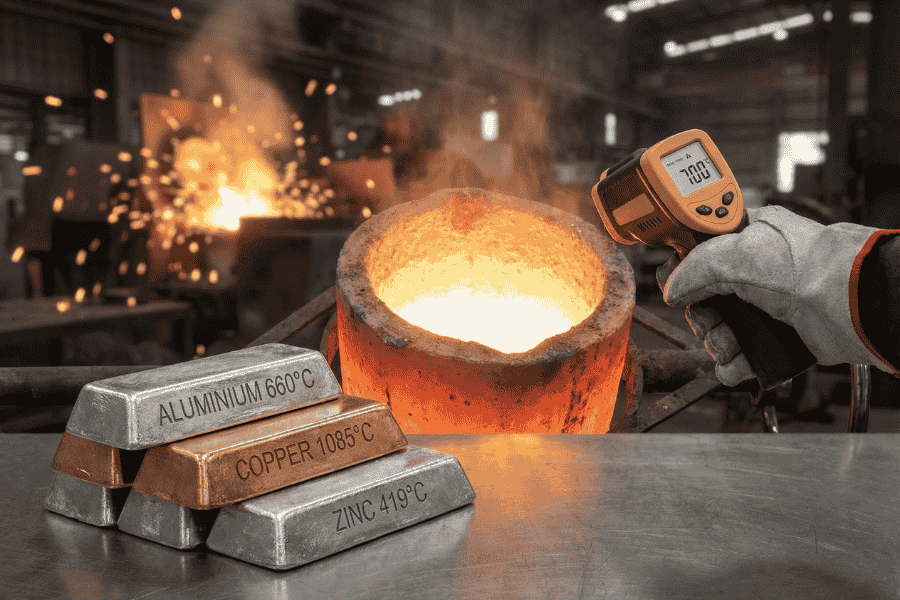
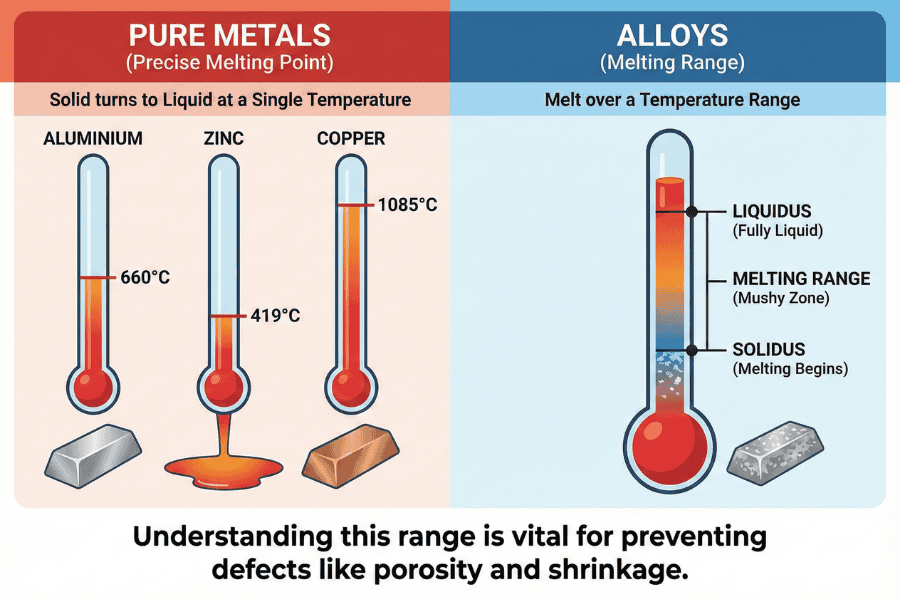
The melting point is the specific temperature at which a solid turns into a liquid. For pure metals, this is a precise figure: Aluminium melts at 660°C, Copper at 1085°C, and Zinc at 419°C. However, in casting, we rarely use pure metals. We use alloys. Alloys melt over a temperature range, starting at the “Solidus” point (where melting begins) and ending at the “Liquidus” point (where it is fully liquid). Understanding this range is vital for preventing defects like porosity and shrinkage.
Why Melting Point Matters in the Foundry
To the layman, melting metal is simply about getting it hot enough to pour. To the foundry engineer, the melting point dictates almost every decision in the manufacturing process.
1. Mould Material Selection
The melting point of the alloy determines what the mould can be made of. For lower melting point metals like Zinc (approx 400°C) or Aluminium (approx 600°C to 660°C), we can use metal dies (Permanent Mould Casting) because the tool steel of the mould can withstand these temperatures without degrading too quickly.
However, for high melting point Copper alloys (which can reach 1100°C), metal dies would degrade rapidly due to thermal shock. Therefore, these are typically produced using Sand Casting or Investment Casting, where the refractory sand or ceramic materials can easily withstand the intense heat without losing their shape.
2. Fluidity and “Superheat”
We never pour metal exactly at its melting point. If we did, it would begin to freeze the moment it touched the pouring cup. We need to add “superheat.” This is the extra temperature added above the melting point to ensure the metal stays liquid long enough to travel through the runner system and fill the entire cavity.
Knowing the exact melting point allows us to calculate the precise superheat required (usually 50°C to 100°C above liquidus). Too much superheat wastes energy and increases gas absorption; too little results in cold shuts.

Melting Points of Common Non-Ferrous Metals
At Castech, we specialise in a variety of non-ferrous materials. Here is how they behave thermally.
Aluminium (660°C)
Aluminium is the workhorse of the non-ferrous world. Pure aluminium melts at roughly 660°C. However, casting alloys like LM25 or LM6 contain Silicon, Magnesium, or Copper to improve strength and castability. Interestingly, adding alloying elements often lowers the melting point. For example, a eutectic Aluminium-Silicon alloy can melt at around 577°C.
This relatively low temperature makes Aluminium Castings highly energy efficient to produce compared to copper-based alternatives. However, aluminium is highly reactive to oxygen and hydrogen at these temperatures, meaning strict degassing controls are required during the melt.
Copper (1085°C)
Copper has a significantly higher melting point, requiring more energy and robust refractory materials.
Brass: This is an alloy of Copper and Zinc. Depending on the ratio, Brass typically melts between 900°C and 940°C. The addition of Zinc lowers the melting point of pure Copper.
Bronze: An alloy of Copper and Tin. Bronze typically melts at around 950°C to 1050°C, depending on the tin content.
Because these temperatures are high, safety and refractory management in the foundry become even more critical.
Zinc (419°C)
Zinc has one of the lowest melting points of any structural metal. This makes it exceptionally fluid and easy to cast, which is why it is the standard for high-volume, high-pressure die casting. It places very little thermal stress on the dies, allowing for extremely long tool life.
The Science of Alloys: Solidus and Liquidus
This is where the science becomes interesting. A pure element like Gold or Copper has a sharp melting point. It stays solid until it hits that specific degree, and then it turns to liquid.
However, most engineering metals are alloys (mixtures). Alloys do not melt at a single point; they melt over a range.
The Mushy Zone
When you heat an alloy, it reaches a temperature called the Solidus. At this point, it begins to melt, but it is not yet fully liquid. It creates a slushy mix of solid crystals floating in liquid metal. This is known as the “mushy zone” or pasty range.
As you continue to heat it, it reaches the Liquidus temperature. Above this point, the metal is 100% liquid and ready to pour.
Why This Matters for Casting
The width of this “mushy zone” changes how the metal freezes in the mould.
Short Freezing Range: Metals with a narrow gap between Solidus and Liquidus (like pure Aluminium or eutectic alloys) freeze quickly. This is great for detail, but can make feeding the casting difficult as the gates freeze shut rapidly.
Long Freezing Range: Alloys with a wide gap stay “mushy” for a long time. This allows the pressure of the riser to feed molten metal into the casting for longer, helping to prevent shrinkage porosity in thick sections.
When we design a Gravity Die Casting tool or a sand mould, we have to look at the phase diagram of the specific alloy to understand this freezing range. It dictates where we place the risers and how we control the cooling.
Common Thermal Defects
If the melting point and pouring temperature are not strictly controlled, the casting will fail.
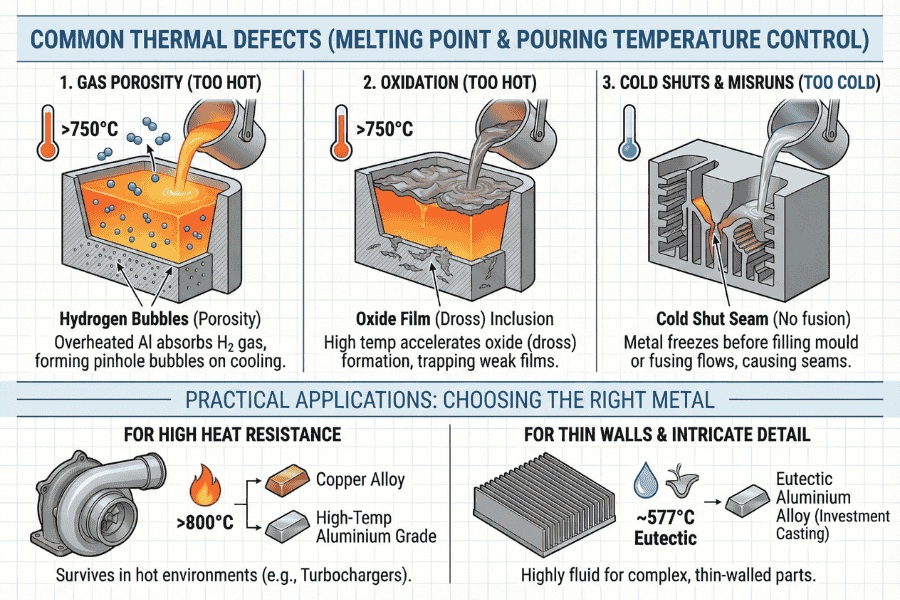
1. Gas Porosity (Too Hot)
There is a temptation to overheat the metal to ensure it flows easily. This is dangerous. As the temperature of Aluminium rises, its ability to absorb Hydrogen gas from the atmosphere increases exponentially. When the metal cools, this gas is forced out, creating tiny pinhole bubbles (porosity) throughout the part.
2. Oxidation (Too Hot)
Non-ferrous metals are reactive. Overheating them accelerates the formation of oxides (dross). If this oxide film gets trapped inside the casting, it creates a weak point or a leak path, which is disastrous for pressure-tight components.
3. Cold Shuts and Misruns (Too Cold)
If the metal is poured too close to its liquidus point, it may freeze before it fills the intricate details of the mould. A “cold shut” occurs when two flows of metal meet but are too cold to fuse, leaving a visible seam or crack.
Practical Applications: Choosing the Right Metal
When a customer comes to Castech with a design, the melting point of the material often dictates the manufacturing route.
For High Heat Resistance: If the final component needs to survive in a hot environment (like a turbocharger housing), we might choose a high melting point Copper alloy or a specific high-temperature Aluminium grade.
For Thin Walls: If the design has very thin, complex fins (like a heat sink), we need a fluid alloy. We might look for an eutectic Aluminium alloy with a lower melting point that flows like water, casting it using the Investment Casting process for maximum detail.
Conclusion
The melting point is not just a number on a datasheet. It is the defining characteristic that dictates how a metal behaves, how it is processed, and how it performs. From the energy efficiency of Aluminium to the high temperature resilience of Bronze, understanding thermal properties is essential for success.
For more technical data on material properties, resources like MatWeb are invaluable for engineers. Additionally, the Cast Metals Federation provides industry standards for British foundries.